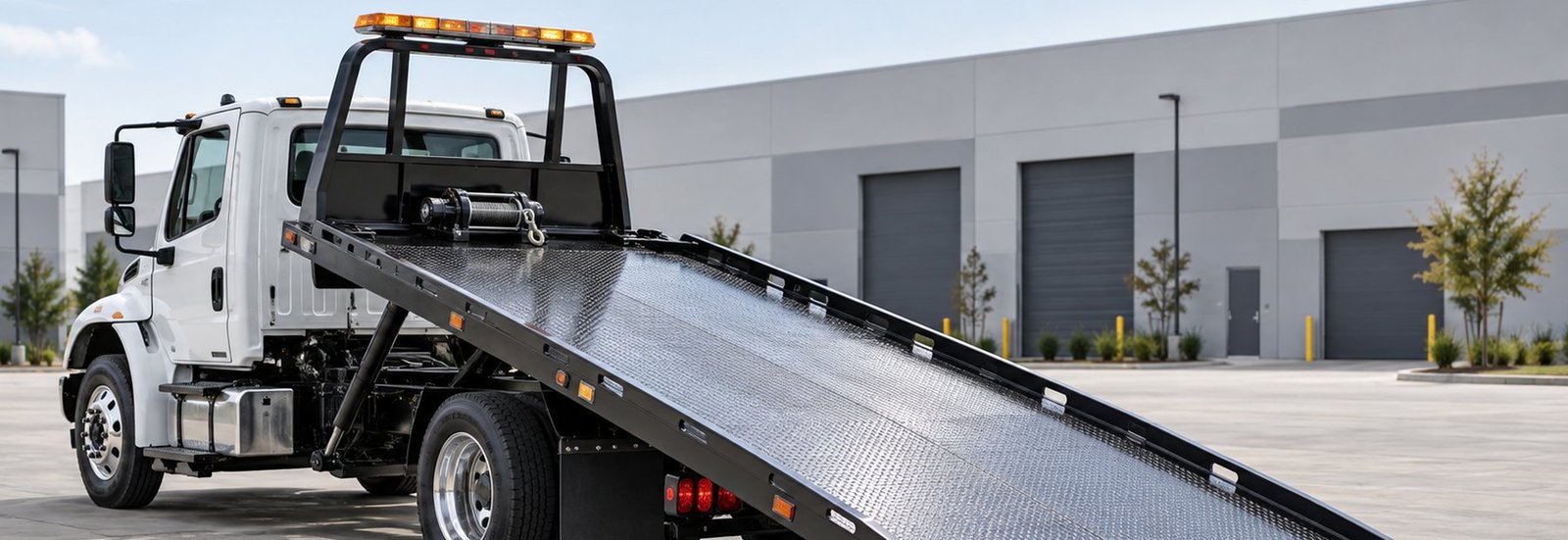
Tow truck insurance is not one policy. It is a set of coverages that each answer for a different moment in the job: driving, hooking, hauling, storing, and standing on the shoulder at 2am.
Loading is where most on-hook claims begin
Required by law
Commercial auto liability
Bodily injury and property damage your truck causes to third parties. This is the foundation, and it is what regulators and contracts check first. Most towing operators carry $1,000,000 combined single limit or higher because that is what cities and motor clubs ask for.
Pays when: your driver rear-ends a car on the way to a call.
Required by lenders
Physical damage
Comprehensive and collision on your own trucks: chassis plus the body, bed, boom and wheel lift. Insure the value of the upfit, not just what the chassis is worth. Heavy wreckers are normally written on a stated-value basis with an equipment schedule.
Pays when: your wrecker rolls during a winch-out.
Required by contracts
On-hook / cargo
Damage to the vehicle you are towing, from hookup until you release it. Standard commercial auto excludes property in your care, custody or control, which is exactly what a towed vehicle is. Limits are set per vehicle, so operators moving luxury or electric vehicles should carry well above the minimum.
Pays when: a chain fails and the car shifts on the deck.
Required by contracts
Garagekeepers
Customer vehicles stored on your lot or impound yard. The form matters more than the limit. Legal liability pays only when your negligence caused the loss. Direct primary pays regardless of fault, which is why storage operations carry it. The limit is written per location, so a second yard has to be scheduled.
Pays when: hail dents a row of stored cars, or a fire starts in the yard.
Required by contracts
General & garage liability
Third-party injury and damage connected to your business rather than your vehicle: the office, the yard, the counter where people pay release fees, and the work your crew does once they are out of the truck. Garage liability is the auto-industry version of the same idea.
Pays when: a customer slips crossing your lot.
Required by law, and by clubs
Workers' compensation
Medical costs and lost wages when a driver is hurt on the job. California requires it once you have employees, and the DMV's Motor Carrier Permit process asks for either proof of coverage or a signed exemption. Many motor clubs and city contracts want the certificate regardless of headcount.
Pays when: a driver is struck working the shoulder.
Worth asking about
Excess & umbrella
Extra limit sitting on top of your auto and general liability. For towing this is not a luxury. A single freeway incident with injuries to more than one person can run straight through a $1,000,000 primary limit. Some municipal and rotation contracts require it outright.
Pays when: the primary limit runs out and the claim keeps going.
Depends on your operation
Endorsements to flag
Hired and non-owned auto for rented trucks or an employee's own vehicle on company business. Uninsured motorist and medical payments for your own drivers. Trailer interchange if you move equipment that is not yours. Repossession is underwritten separately and never assumed under a general tow policy.
Worth knowing: undisclosed repo work is a common reason a claim gets contested.
California paperwork
The filings that keep you dispatchable
In California, insurance is not only protection. It is the thing that keeps your permit alive and your name on the rotation list. Getting the proof filed correctly matters as much as the limit itself. Arizona and Texas run their own filing rules, so ask before you assume they match.
DMV
Motor Carrier Permit
California for-hire property carriers operate under an MCP issued by the DMV. Your insurer has to file proof of insurance with the DMV directly, because a certificate in the glovebox is not a substitute, and the permit is renewed annually.
CHP
CA number
The CA number on your doors is issued by the CHP and is required before the MCP goes through. Since 2016 the CHP will not issue one without a USDOT number on file.
Rotation
CHP rotation minimums
Operators on a CHP rotation list under a Tow Service Agreement are held to set coverage minimums, commonly cited as $100,000 on-hook and $50,000 garagekeepers. Your own agreement and beat govern, so I read yours before we set limits.
Contracts
Motor club & city certificates
Clubs and municipalities usually want to be named on the certificate with specific wording, and they want the renewal in hand before the old one lapses. Miss that date and dispatch stops calling.
Before you compare quotes
What actually moves your premium
Two operators with identical trucks get quoted very differently. Almost always it comes down to these three, which is also where the savings are, if any exist.
Driver records
Motor vehicle records carry more weight in towing than almost any other factor. Cleaning up your driver list before the account goes to market will move a quote further than shopping another carrier.
Radius and work type
A 50-mile private-property impound operation is a different risk to a statewide heavy recovery outfit running freeway calls at night. Describe it honestly. A cheap quote built on a wrong description is not a saving.
Loss history
Three to five years of loss runs drive the rate. Small, frequent on-hook claims can hurt more than one large loss, because frequency reads as a process problem. Documented securement training is worth putting in the submission.
Straight answers
Questions operators ask first
Does my commercial auto policy already cover the cars I tow?
No. Commercial auto covers damage your truck causes to other people. Property in your care, custody or control is excluded, and a vehicle on your hook is exactly that. You need on-hook for transit and garagekeepers for storage. This is the single most common gap in towing programs.
What is the real difference between on-hook and garagekeepers?
Timing and location. On-hook applies while the vehicle is hooked, loaded or in transit. Garagekeepers applies once it is parked at your facility. The same vehicle damaged by a strap failure on the freeway is an on-hook claim. Damaged by hail on your lot the next morning, it is a garagekeepers claim. Carrying only one leaves half the day uncovered.
How much does tow truck insurance cost?
Published ranges are close to useless as a quote. Industry guides for 2026 put single-truck packages somewhere in the several-hundred-dollars-a-month range, but California, your radius, driver records, loss history and equipment values move that figure enormously. A real number takes a submission. Anyone quoting you firmly without seeing your driver records and loss runs is guessing.
I do repossession work. Does that change things?
Yes, significantly. Repossession carries confrontation risk that many standard carriers decline outright or surcharge heavily. It has to be disclosed before you bind. It will not be assumed under a general towing policy, and an undisclosed repo claim is a bad place to find that out. Specialty markets exist for it, so the coverage just has to be built deliberately.
Do I need workers' comp if it is just me and one truck?
California requires workers' compensation once you have employees, and the DMV's Motor Carrier Permit process asks for either proof of coverage or a signed exemption. Separately, many motor clubs and city contracts want a workers' comp certificate regardless of how small you are. Tell me your structure and I will tell you which applies to you.
What do you need to put a quote together?
Your current declarations page, a truck list with VINs and values, a driver list with dates of birth and licence numbers, three to five years of loss runs if you have them, and a description of the work: radius, who dispatches you, whether you store, and whether you touch repossession. If pieces are missing, start with the dec page.
Can you handle my house and personal vehicles too?
Yes. Across personal, commercial, life and specialty lines, the truck policy, the home, the family's cover and the business planning can sit in one place, and somebody is actually looking at how they overlap.
Let's look at what you are carrying now
Send the declarations page on its own. You will get a plain read on what it covers and what it misses, with no obligation attached to it.